
Last updated September 20, 2026
 Before
 After
After Before
 After
After Before
 After
AfterTable of Contents
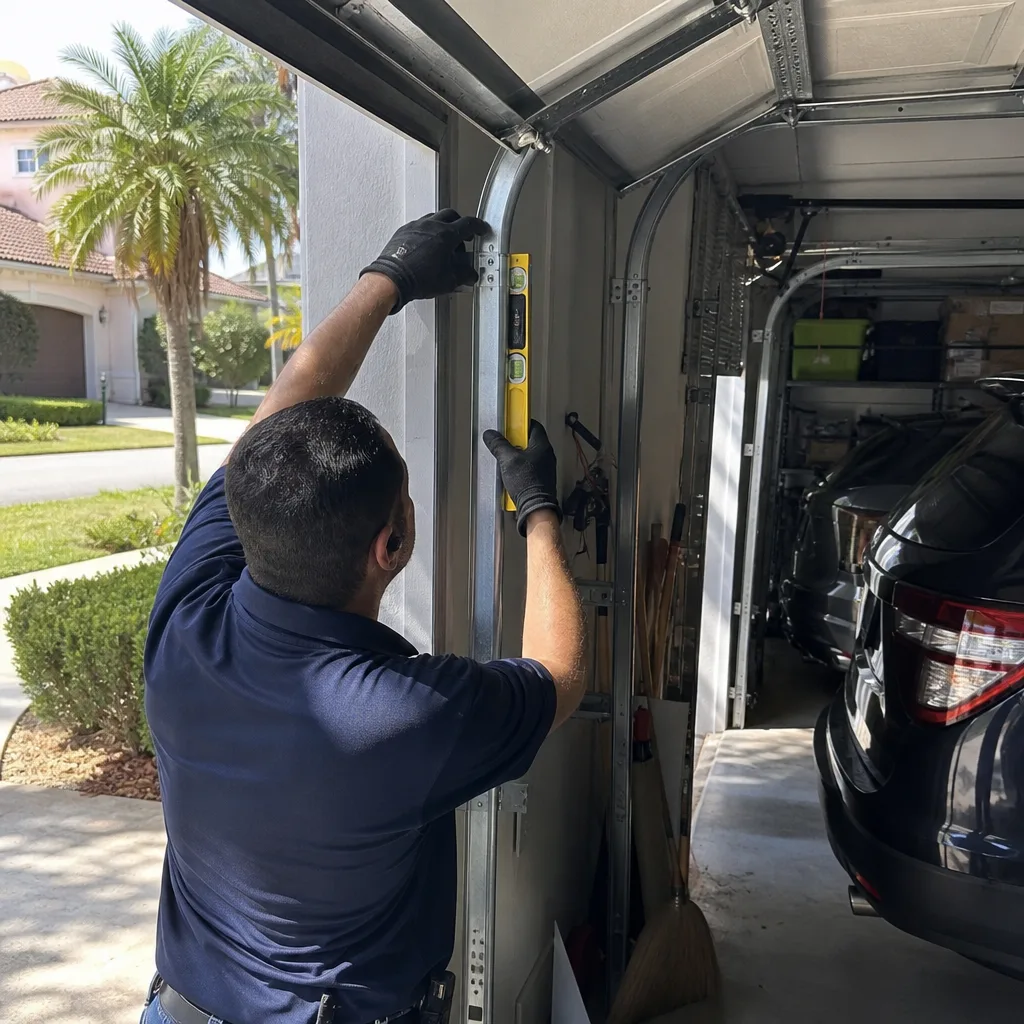
- The Three-Tier System: Urgent, Scheduled, Monitor
- Symptom-to-Component Mapping: What That Noise Actually Means
- How to Tell a Broken Torsion Spring from a Broken Cable (Visually, From the Ground)
- South Florida-Specific Warning Signs: What Davie’s Climate Does to Garage Doors
- The Documentation Rule: Why You Photograph Before You Call
- What Servo Actually Sees on Davie Doors: A Field Report
- Common Mistakes to Avoid
- When to Call a Professional
- Frequently Asked Questions
The Three-Tier System: Urgent, Scheduled, Monitor
Every garage door symptom falls into one of three buckets. Getting the bucket right saves money. Getting it wrong means either paying for an emergency call that wasn’t one, or ignoring a component that’s about to put a 150-pound door section on your car. Here’s the framework we use when a Davie homeowner describes a symptom over the phone before we send anyone out.
Tier 1: Urgent (Stop Using the Door)
These symptoms mean the door’s weight-bearing components have failed or are about to. Close the door manually if you can do so safely, lock it, and call. Do not use the opener.
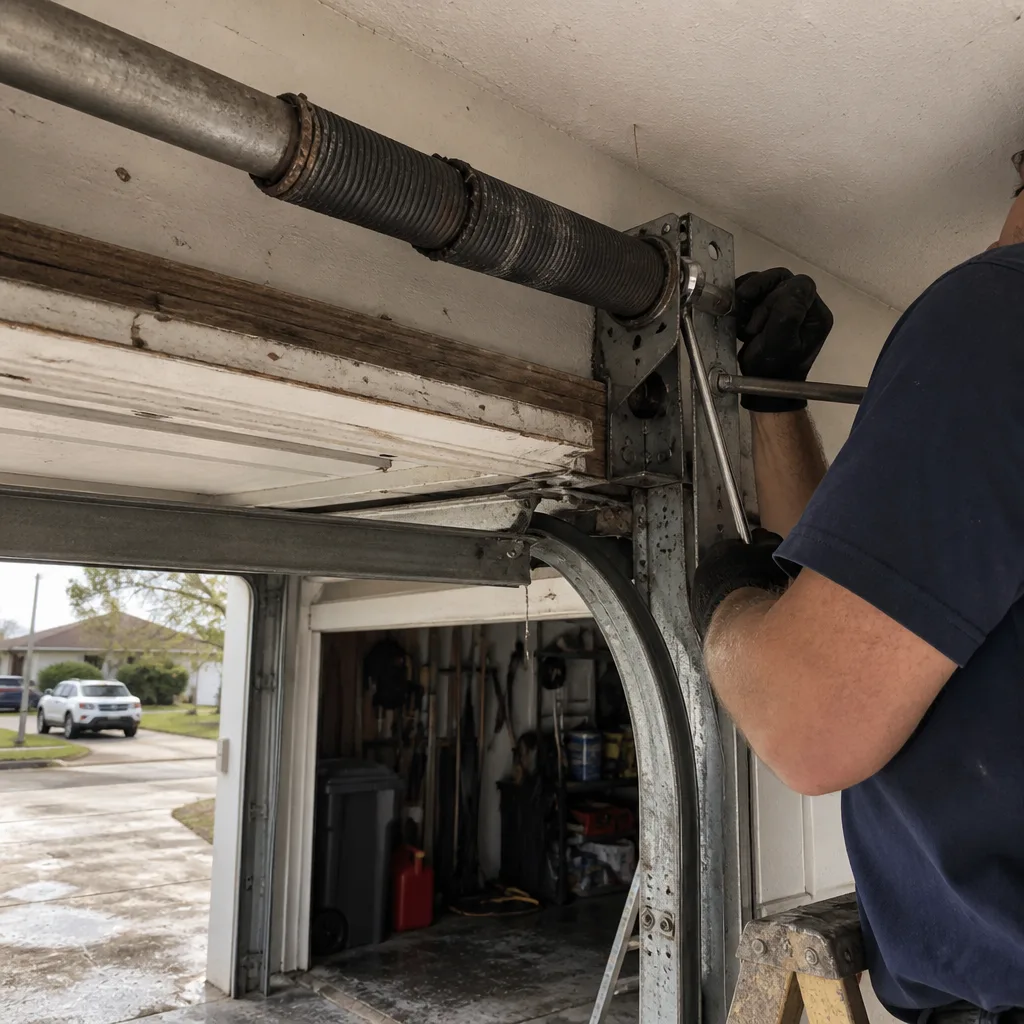
- Visible break in a torsion spring: You’ll see a two-inch gap in the coil, usually mid-spring, often at the top of the door when it’s closed. The spring is under extreme tension and has already released it; the door is now dead weight.
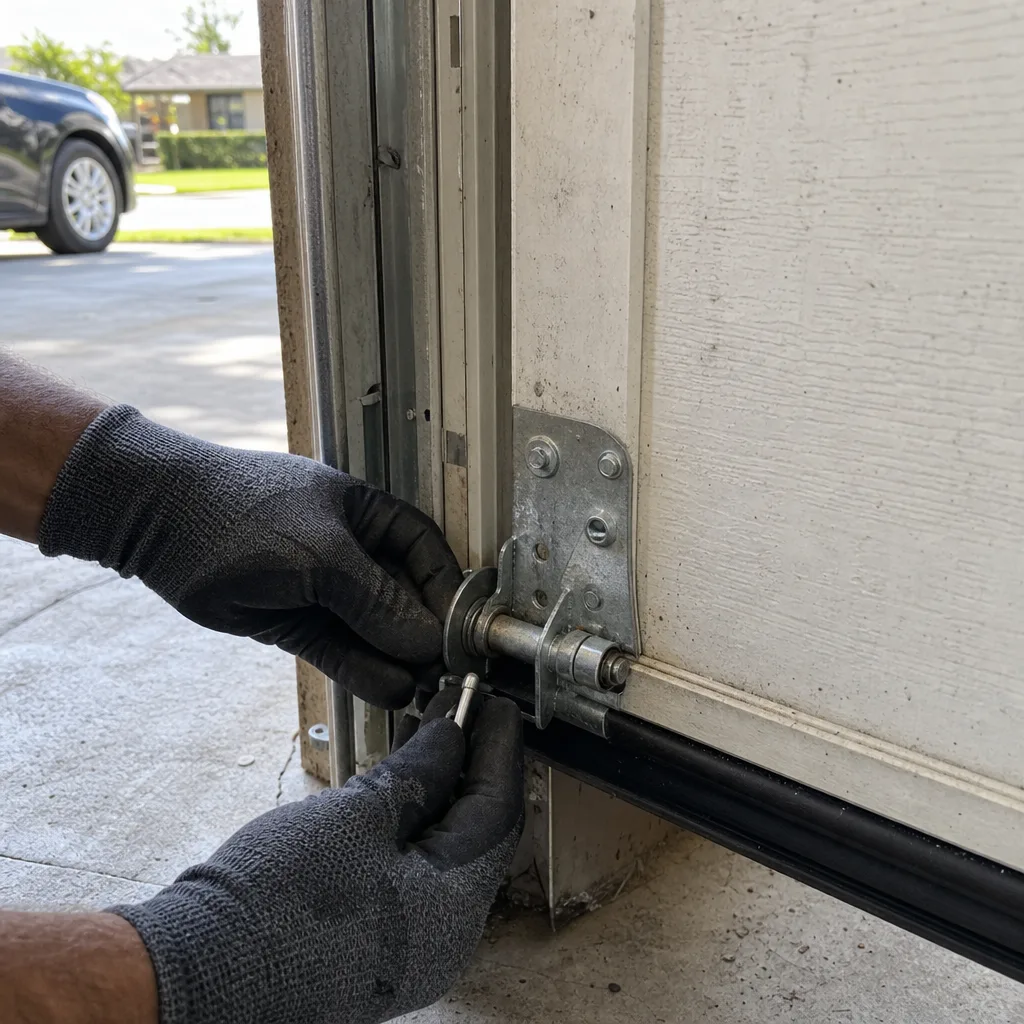
- Frayed or snapped cable: Look for loose wire strands near the bottom roller bracket or a cable hanging slack from one side. A snapped cable means the remaining cable is now carrying the entire side load.
- Door falls or drops when released: Pull the red emergency release cord and try to move the door by hand. If it slams down or won’t stay up at waist height, the spring system is not counterbalancing the weight. That’s a spring problem, not just a nuisance.
- Panel separated from hinges or hardware: If a panel has torn at the hinge line or a roller has popped out of the track, the door’s structural path is compromised.
Tier 2: Scheduled (Book Within 30 Days)
These symptoms are warning signs that something is degrading, but the door is still safe to operate in the short term. Book the repair, don’t ignore it for six months.
- Slow travel or hesitation: The door moves but labors, especially in the first two feet of opening.
- Grinding on one side: A metal-on-metal sound localized to the left or right track often points to a failing roller, not the motor.
- Rust streaking on cables or hardware: Corrosion has started and will only progress, especially in Davie’s salt-air and humidity profile.
- Uneven floor gap at rest: The door sits lower on one side by more than half an inch, suggesting a worn cable drum or a settling track.
Tier 3: Monitor (Document and Watch)
These signs are worth recording with a photo and a date. Most of them cost nothing to monitor, and many never turn into repairs.
- White oxidation on aluminum panels: This is the early stage of coating failure. It’s not a structural problem, but it’s worth documenting so you know if it’s spreading.
- Minor panel dents under three inches: Cosmetic, unless the dent crosses a hinge line or cracks the panel from edge to edge.
- Small floor gap inconsistencies under half an inch: Normal in homes that settle, which includes most of Davie’s residential neighborhoods built on reclaimed or shifting soil.
- Faint squeak on one side: Often a lubrication issue, not a component failure. Mark the date, note the side, and move on.
Symptom-to-Component Mapping: What That Noise Actually Means
Garage doors don’t make random sounds. Each sound, speed change, and visual irregularity narrows the possible component. Here’s the mapping we use on every garage door repair in Davie, and it works just as well for a homeowner trying to decide whether to call.
Slow Travel
A door that moves slower than it used to often points to one of three things: the torsion spring is losing tension and not counterbalancing the full weight, the opener’s gear and sprocket assembly is wearing (common on older Chamberlain and Genie units), or the rollers have accumulated so much friction that the opener is working against them. The test we use: disconnect the emergency release and try moving the door by hand. A door that’s heavy by hand is a spring issue. A door that moves fine by hand but labors under the opener is an opener or roller issue.
Grinding on One Side
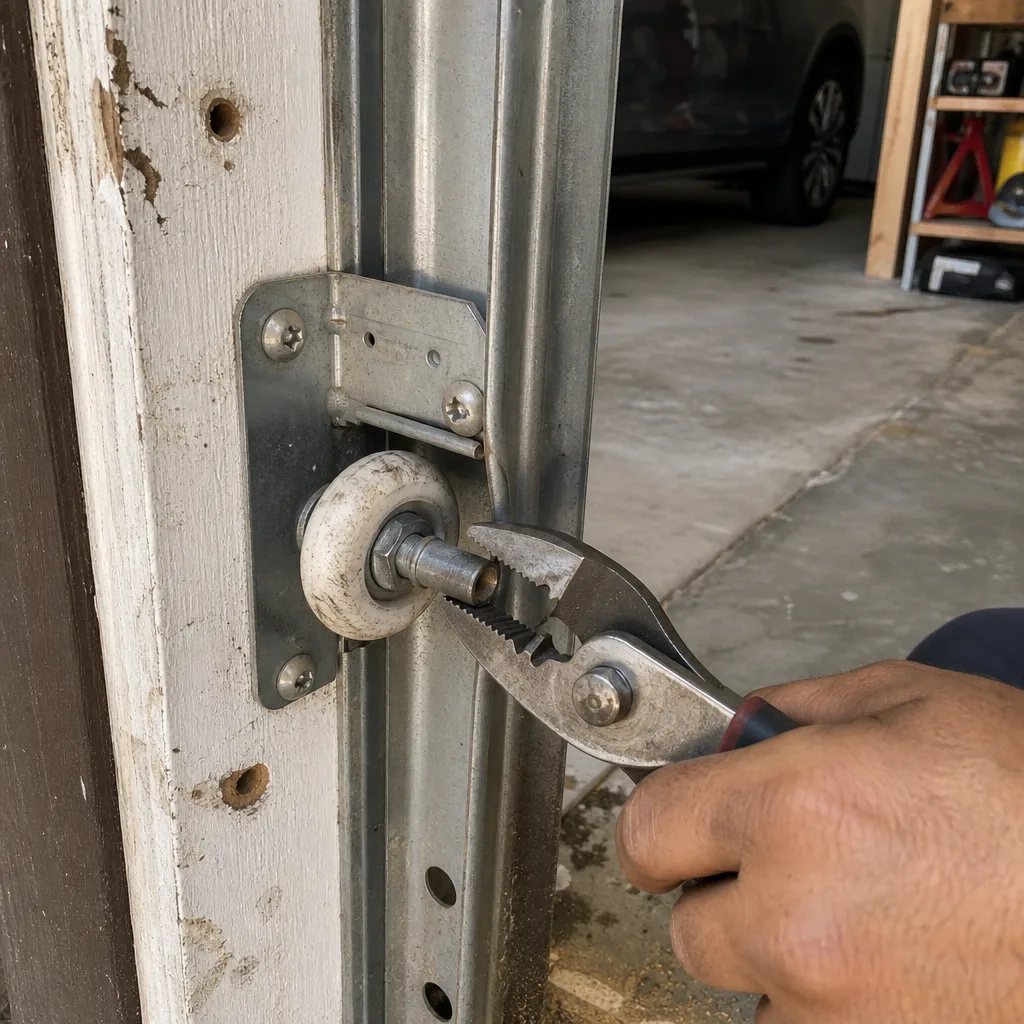
This is almost always a roller problem, not a track problem. Rollers are steel or nylon wheels that ride inside the track on each side of the door. When one fails, it stops rolling and starts sliding, producing that metal-on-metal grind. In our experience with Davie doors, the most common failure point is the bottom roller bracket on the side that gets more sun exposure or more salt-laden air. The fix is usually a roller replacement, not a track replacement. If you hear grinding from the center of the door, that’s a different story: it’s the opener’s trolley carriage dragging on the rail, and it points to a worn carriage or a dry rail.
Uneven Gap at the Floor
When a closed door shows more daylight on one side than the other, the likely culprits are a cable drum that’s no longer winding evenly, a cable that has slipped on the drum, or a track that has shifted out of alignment. The cable drum is the spool at each end of the torsion shaft that winds and unwinds cable as the door moves. If one drum isn’t spooling evenly, one side of the door lifts before the other. On most Davie homes, this also shows up as a door that shudders on the way up. It’s a scheduled repair because the uneven load wears the rollers and hinges faster.
Reversing Before It Touches the Floor
If the door closes most of the way and then reverses, this is almost never a spring problem. It’s a travel limit or force setting issue in the opener. Most openers use a threaded limit switch or a small module that tells the motor where “floor” is. When it drifts out of calibration, the opener thinks the floor is higher than it is. The fix is a limit adjustment, and on most LiftMaster units it’s a two-screw procedure that takes under four minutes. Homeowners who call a dispatch service for this pay for a service call and a screwdriver turn. This is the clearest example of a symptom that belongs in Tier 3 until you’ve confirmed it’s not something else.
Door Rises Unevenly or Binds Mid-Travel
When the door rises and then catches, the problem is usually a track misalignment or a bent track section. South Florida’s heat can cause the aluminum track brackets to shift subtly over years, especially on west-facing garage doors where the afternoon sun beats on the exterior. A door that binds mid-travel is a scheduled repair, but it becomes urgent if the door hangs at a visible angle while open. That means the track has shifted enough that a roller could pop out.
How to Tell a Broken Torsion Spring from a Broken Cable (Visually, From the Ground)
These two failures look similar to the untrained eye because both leave the door unable to open. But the repair is different, the cost is different, and the urgency is different. Here’s how to tell them apart without putting a ladder against the door or touching anything under tension.
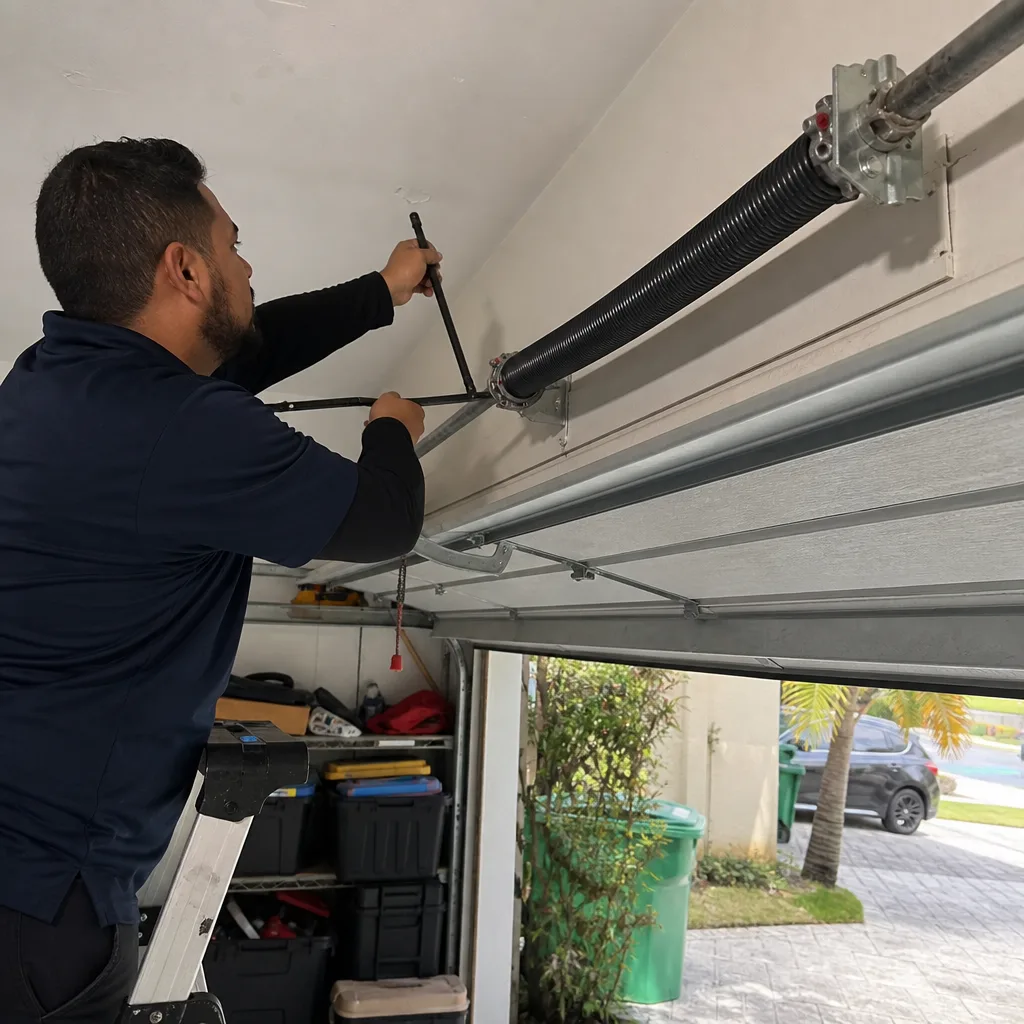
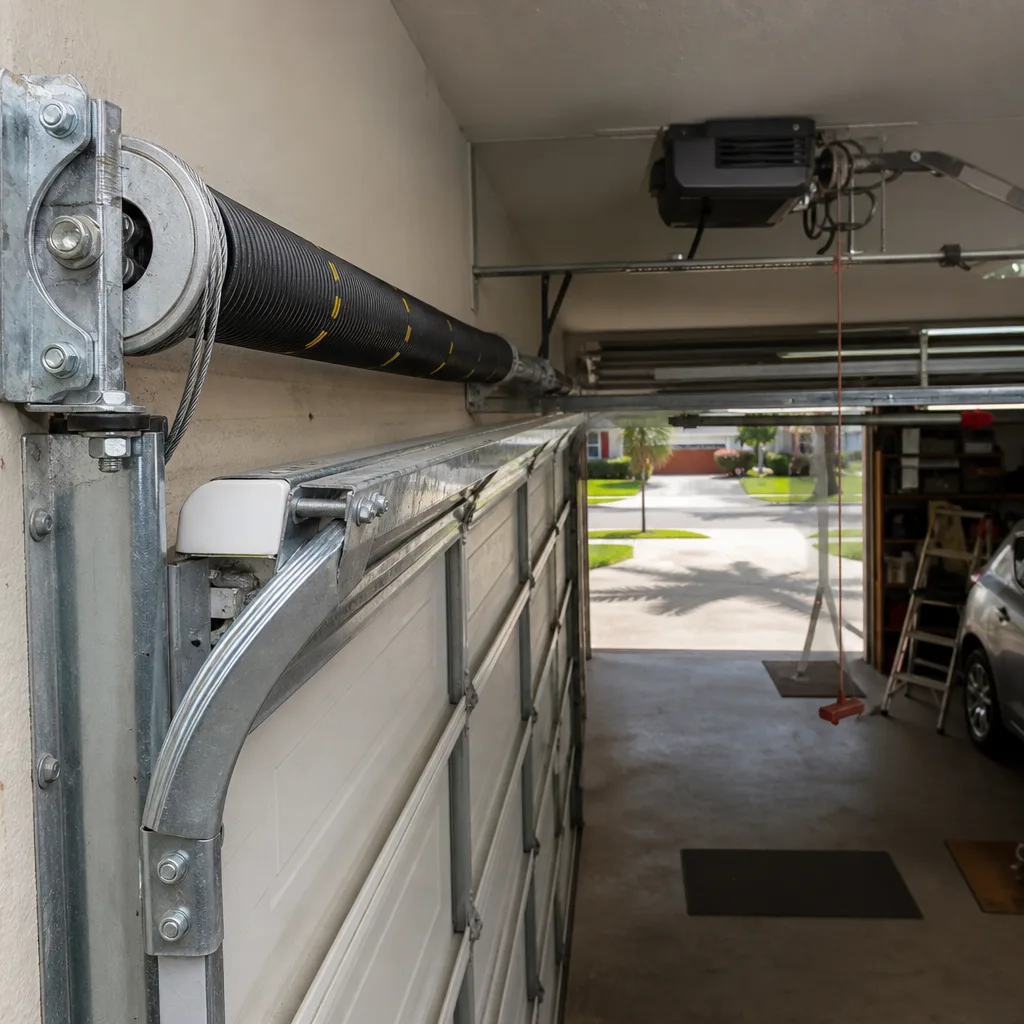
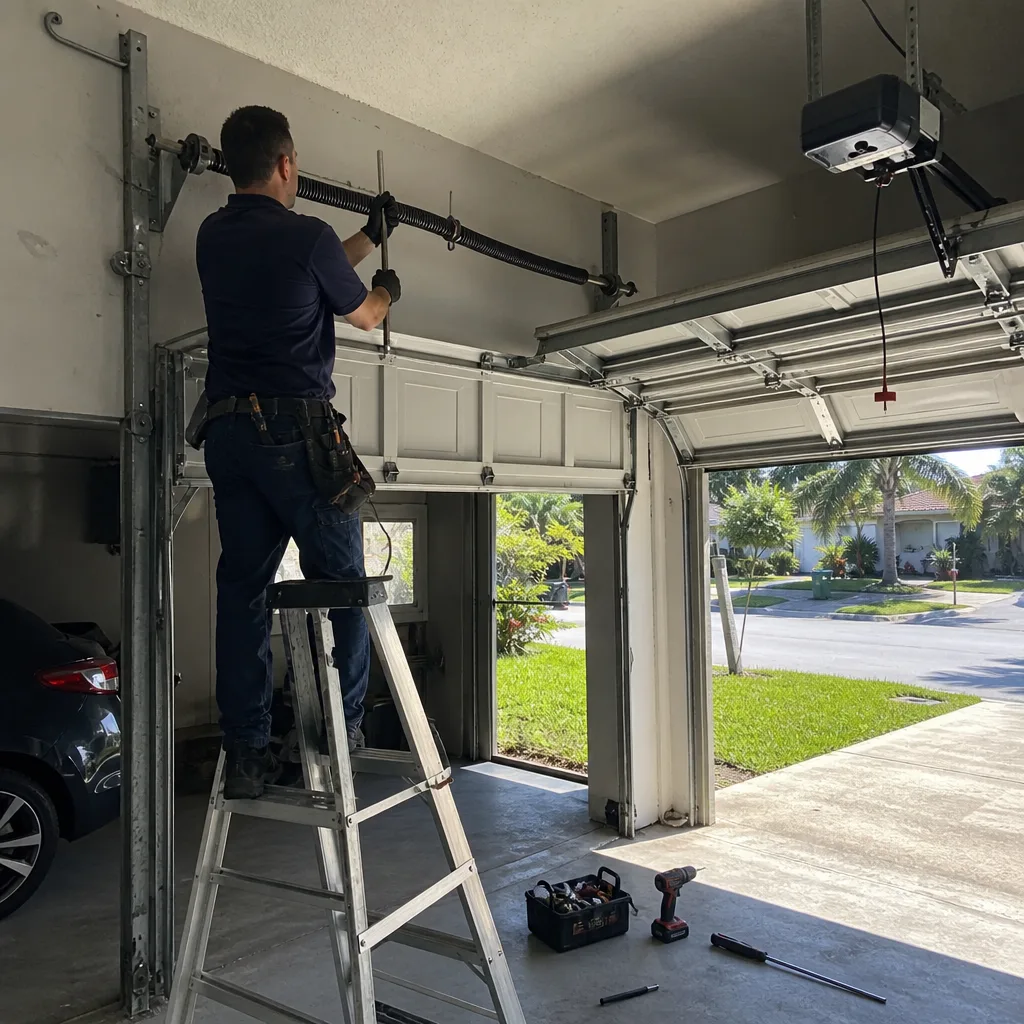
- Look at the top of the door when it’s closed. The torsion spring is a coil that sits horizontally on the bar above the center of the door. A broken torsion spring shows a visible gap in the coil, usually two to three inches, where the steel snapped clean through. The two halves of the spring don’t touch.
- Look at the sides of the door, near the bottom roller. The cables are steel wires that run vertically on each side, from the bottom bracket up to the cable drum. A broken cable looks slack, frayed, or completely separated. You may see loose wire strands hanging from the drum or a cable that’s lying limp against the track.
- Check what happens when you try to lift the door manually. If the spring is broken but the cables are intact, the door is incredibly heavy. You may not be able to lift it more than a few inches. If a cable is broken but the spring is intact, the door may lift but it will bind on one side or lean as it rises.
- Listen. A torsion spring that snaps while the door is closed often makes a loud crack that homeowners report hearing from inside the house. A cable that snaps is quieter, often described as a twang or a snap with less force behind it.
If you’re not certain which component has failed, don’t guess. On any visual inspection, keep your hands away from the torsion bar and the cable drums. These components hold stored mechanical energy. A technician with a background-checked presence in your driveway is the right call, not a YouTube diagnosis.
South Florida-Specific Warning Signs: What Davie’s Climate Does to Garage Doors
Garage doors in Davie face a climate that most manufacturers don’t design for specifically. The combination of high humidity, salt-laden air from the Atlantic, and intense UV exposure creates warning signs that don’t appear in the generic owner’s manuals. Here’s what we see in Davie that homeowners elsewhere don’t.
Rust Streaking on Cables
Rust on a garage door cable is not uniform. It starts at a single point, often where the cable contacts the drum or where the cable rubs against the track. Once corrosion breaks the surface, the rust travels along the cable in a streak, following the path of moisture. A rust streak tells you exactly where the cable’s failure point will be. If you see a streak, photograph it. It’s the starting point for the wire fray that will eventually become a snapped cable.
White Oxidation on Aluminum Panels
Aluminum panels in South Florida don’t rust, but they do oxidize. The first visible sign is a chalky white film on the panel surface, usually starting at the bottom edge where water sits after a rain. That’s the clear coat and paint wearing off, not dirt. Oxidation is cosmetic at first, but it’s the canary in the coal mine for panel coating failure. Once the coating is gone, the aluminum underneath starts pitting, and pitting is not reversible. If you catch oxidation early, a professional refinish can add years. If you wait, the panel is replaceable but the damage is visual proof of neglect.
Salt-Air Corrosion on Hardware
Davie sits close enough to the coast that salt particulate in the air accelerates corrosion on all exposed metal: springs, brackets, hinges, and screws. The classic sign is a rust bloom around the screw heads on the hinges. The screws aren’t failing, but the rust is a clue that the surrounding bracket has lost its protective coating. Left alone, the rust migrates into the hinge pin and the roller stem. When we photograph hardware on Davie doors, we’re looking for corrosion that has passed the cosmetic stage and started to compromise the moving surfaces.
UV Fatigue on West-Facing Panels
A Davie garage door that faces west gets afternoon sun for six to eight months of the year at an intensity that fades paint and weakens polymer components. The warning sign is uneven fading: one panel looks noticeably lighter than the others, or the color has flaked off in patches. Fading itself is cosmetic, but it’s worth noting because a single replacement panel won’t match the rest of the door. If you ever need a panel replaced, the fading will make the repair visible. That’s worth knowing before you commit.
The Documentation Rule: Why You Photograph Before You Call
This is the part of the guide that most homeowners skip, and it’s the part that saves the most money. Before you call anyone about any warning sign, take a photo of the symptom with a timestamp. Not a mental note. A photo.
The reason is simple: quotes are written from what a technician can see on the day of the visit. If a rust streak has spread between the day you photographed it and the day the technician arrives, the quote changes. If a crack in a panel has grown, the repair scope changes. If a cable was frayed on Tuesday and snapped on Thursday, the diagnosis is different entirely. A timestamped photo establishes what the door actually looked like when you noticed the problem.
- Photograph the symptom itself: the gap, the rust streak, the frayed cable, the uneven floor line.
- Photograph the context: a wide shot of the entire door so the symptom’s location is clear.
- Note the date and time. Most phone photos do this automatically in the metadata.
- Send the photo when you request a quote. It lets the technician bring the right parts and gives you a reference point for the written quote.
We built this practice into our own operation from day one. Every visit from Servo Garage Doors Davie includes a documented photo record, not as an add-on but as the standard. Clause 4 of The Haven Standard requires the technician to photograph the failed component before quoting a replacement, so the customer sees the evidence. That’s the paper trail. You’re entitled to one before you hire anyone.
What Servo Actually Sees on Davie Doors: A Field Report
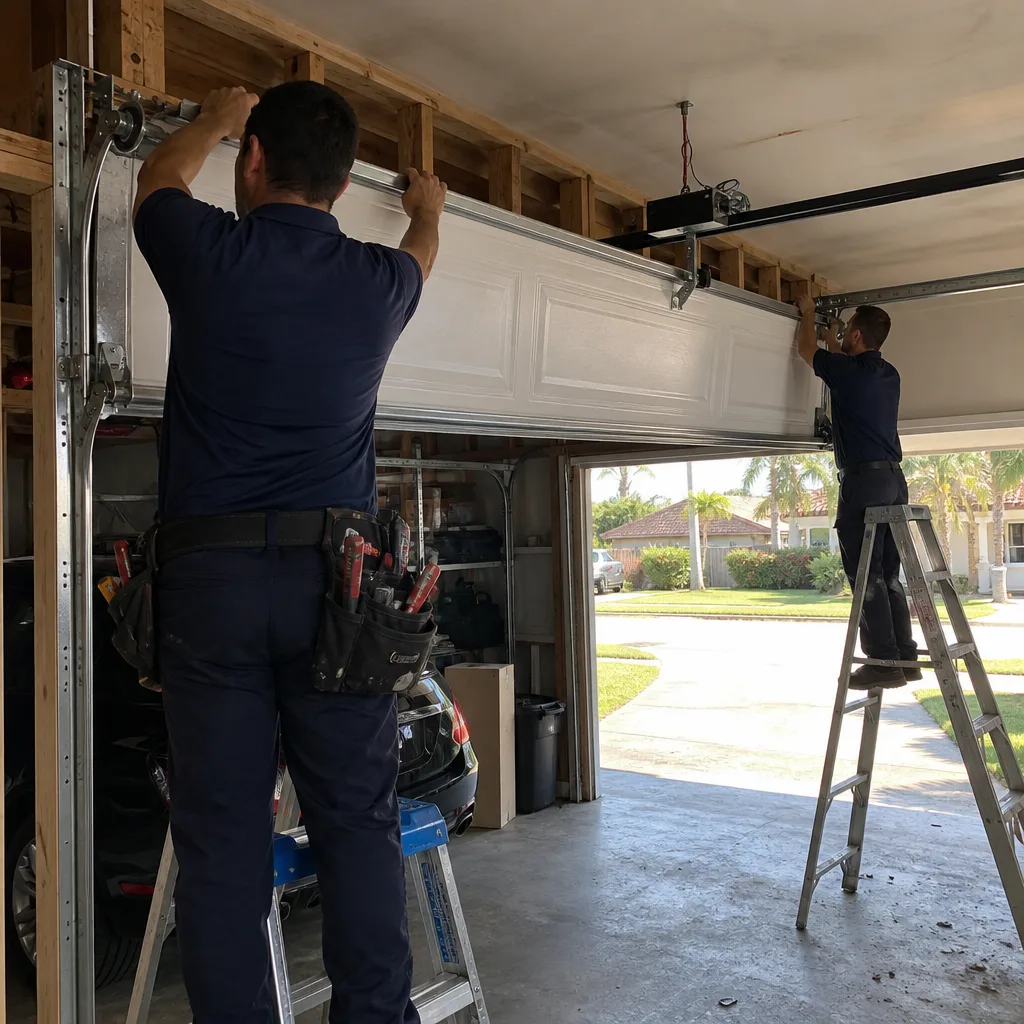
We’ve been at this in Davie since 2015. In that time, certain patterns show up over and over. Here are the warning signs we see most often on the doors we’re called to inspect, and what they typically lead to.
The Broken Spring That Wasn’t Lubricated for Six Years
Torsion springs have a service life, and in Davie’s humidity, that life is shorter than the national average. The pattern: a homeowner in a Davie neighborhood hears a loud snap, finds the garage door won’t open, and calls us. When we measure the spring’s wire diameter and coil count, it’s usually a spring that was installed with the door a decade earlier. The failure doesn’t come from a single event; it comes from a decade of salt-air corrosion eating the spring’s surface. The warning sign was rust accumulation on the spring coils for years before the snap. If you have a spring that’s covered in rust bloom, it’s on borrowed time.
The LiftMaster Opener That Stops Mid-Travel
We see this frequently on LiftMaster and Chamberlain units that are six to nine years old. The opener starts, moves the door halfway, and stops. The warning sign was a door that had been getting gradually slower for months. What’s actually happening is the opener’s logic board is receiving a force reading that tells it to stop because the door is meeting resistance. That resistance is usually a roller that’s seized or a track that’s shifted. The logic board isn’t failing; it’s doing its job. The fix is in the hardware, not the circuit board.
The Wayne Dalton Bottom Panel That Rotted from the Inside
Wayne Dalton and Raynor doors are common in Davie because they’re affordable and widely available. The warning sign we see on these doors is a soft bottom edge on the panel, often with bubbling paint. The panel’s steel skin has rusted through from the back side, where moisture accumulated against the weather seal. By the time the bubbling is visible from the front, the panel has lost structural integrity. This is a Tier 1 warning sign because a bottom panel with internal rot can fail at the hinge line.
Common Mistakes to Avoid
- Calling emergency service for a limit switch issue. A door that reverses before touching the floor is rarely an emergency. Before you pay a premium for a same-day dispatch, check whether the door opens and closes otherwise normally and whether the reversal keeps happening. You may be looking at a scheduled repair with a much lower bill.
- Ignoring a grinding noise because the door still opens. A grinding roller is chewing through the track while you wait. The $80 roller replacement becomes a $400 track replacement and a stranded car if you ignore it long enough.
- Lubricating a spring to “fix” a rust problem. Lubricant doesn’t remove rust and doesn’t restore steel strength. A rusted spring needs to be measured and possibly replaced, not sprayed.
- Assuming a snapped cable is the same as a broken spring. The two failures look similar to a homeowner but require different repairs and different parts. If you’re not sure which one you’re looking at, say so when you call.
- Not photographing the symptom before calling for a quote. The photo is your documentation of what the door looked like when you noticed the problem. It prevents quote changes that aren’t justified by the door’s condition.
- Waiting until the door won’t close to address a gap. An uneven floor gap in Davie often traces to a cable drum that’s slipping. If you wait until the cable jumps the drum entirely, the door can drop on one side. That’s a Tier 1 event.
When to Call a Professional
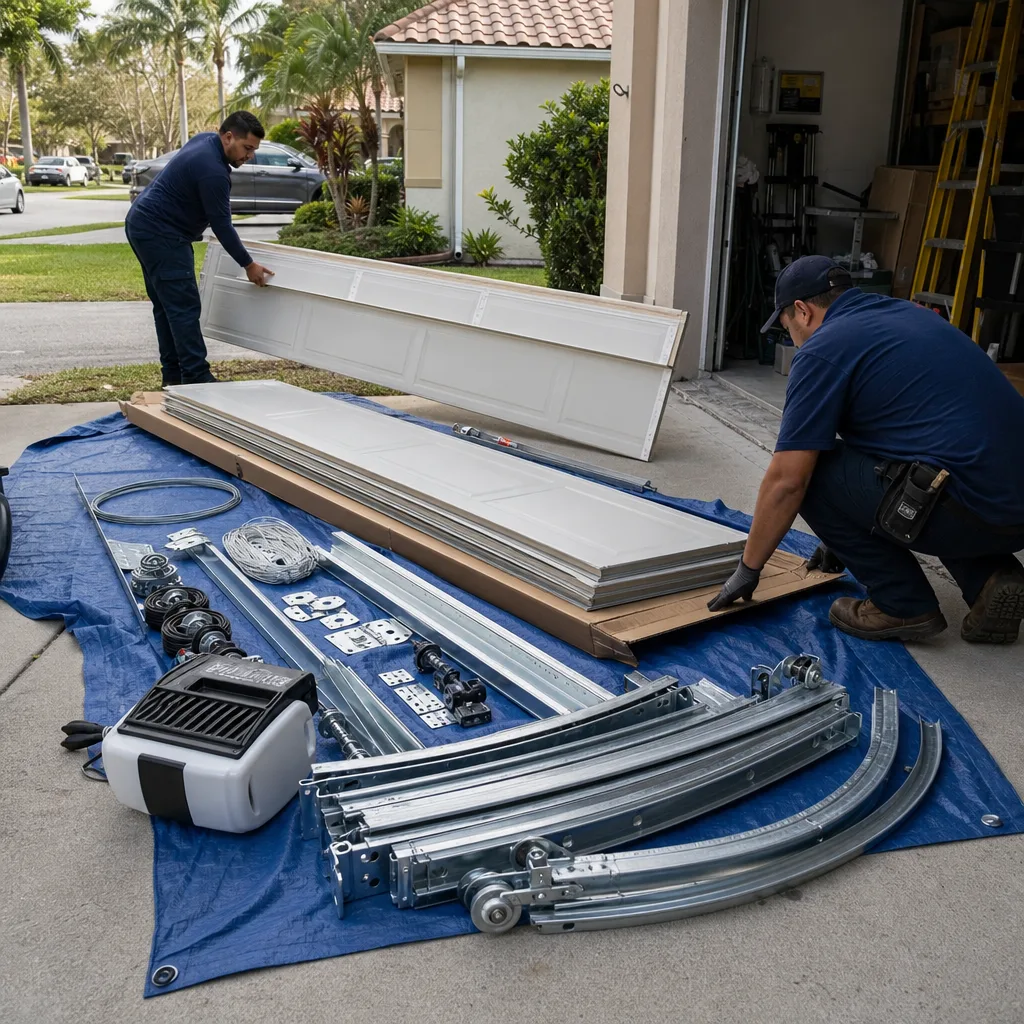
Call a professional when the symptom involves any component under mechanical tension: springs, cables, cable drums, or the torsion shaft. These parts store enough energy to cause serious injury if they fail while you’re working near them. Call when a Tier 1 symptom appears: a snapped spring, a frayed cable, a door that drops when released, or a panel that has separated from its hardware. Call when you’ve classified something as Tier 2 but you’re not sure which component is the source. And call when you want a written price before any work starts. Servo Garage Doors Davie offers free estimates in Davie - call (754) 704-3976 and you’ll get a flat, written price and scope per Clause 1 of The Haven Standard, before a single part is touched.
Frequently Asked Questions
In our experience, the most common warning sign in Davie is a grinding noise on one side of the door, usually caused by a worn roller bearing. It’s a Tier 2 symptom that many homeowners ignore until the roller fails completely. Call (754) 704-3976 for a repair quote - the diagnosis is included in the free estimate.
A problem is urgent if the door’s weight-bearing components have failed or the door can’t be secured. That means a visibly broken torsion spring, a frayed or snapped cable, a door that falls when the emergency release is pulled, or a panel that has separated from its hinges. If the door still opens and closes and the problem is a noise, a gap, or rust, it’s usually a scheduled repair.
No. A door that reverses before touching the floor is usually a travel limit or force setting issue in the opener, not a structural failure. It’s the classic Tier 3 symptom that costs nothing to monitor and very little to fix. If you’re seeing this, note the date and watch whether it gets worse before calling.
A door that’s louder on one side almost always points to a failing roller on that side. The roller stops rolling and starts sliding inside the track, producing a metal-on-metal grind. It’s a scheduled repair with a relatively low parts cost and a clear diagnosis. Replacing a roller is a standard garage door repair in Davie.
We recommend a visual inspection every three months, focused on four things: rust streaks on cables, white oxidation on panels, unevenness in the floor gap, and any noise change. South Florida’s humidity and salt air move corrosion faster than the national average, so a quarterly look is a reasonable schedule for Davie homeowners. Browse more guides & resources for additional maintenance tips.
A rusty spring still works until it doesn’t. Rust is a measurable weakness in the steel, and in Davie’s climate, a spring with visible rust bloom is closer to the end of its service life than a clean one. If you see rust, photograph it and get a professional measurement. The spring’s wire diameter and coil count will tell you whether it needs replacement or has service life remaining.
We provide a free estimate on any garage door repair in Davie, including a visual inspection of the symptom. The estimate includes a flat, written price and written scope, so you know the cost before any work starts. No coupon is needed, and the price doesn’t change once we see the door.
The Bottom Line
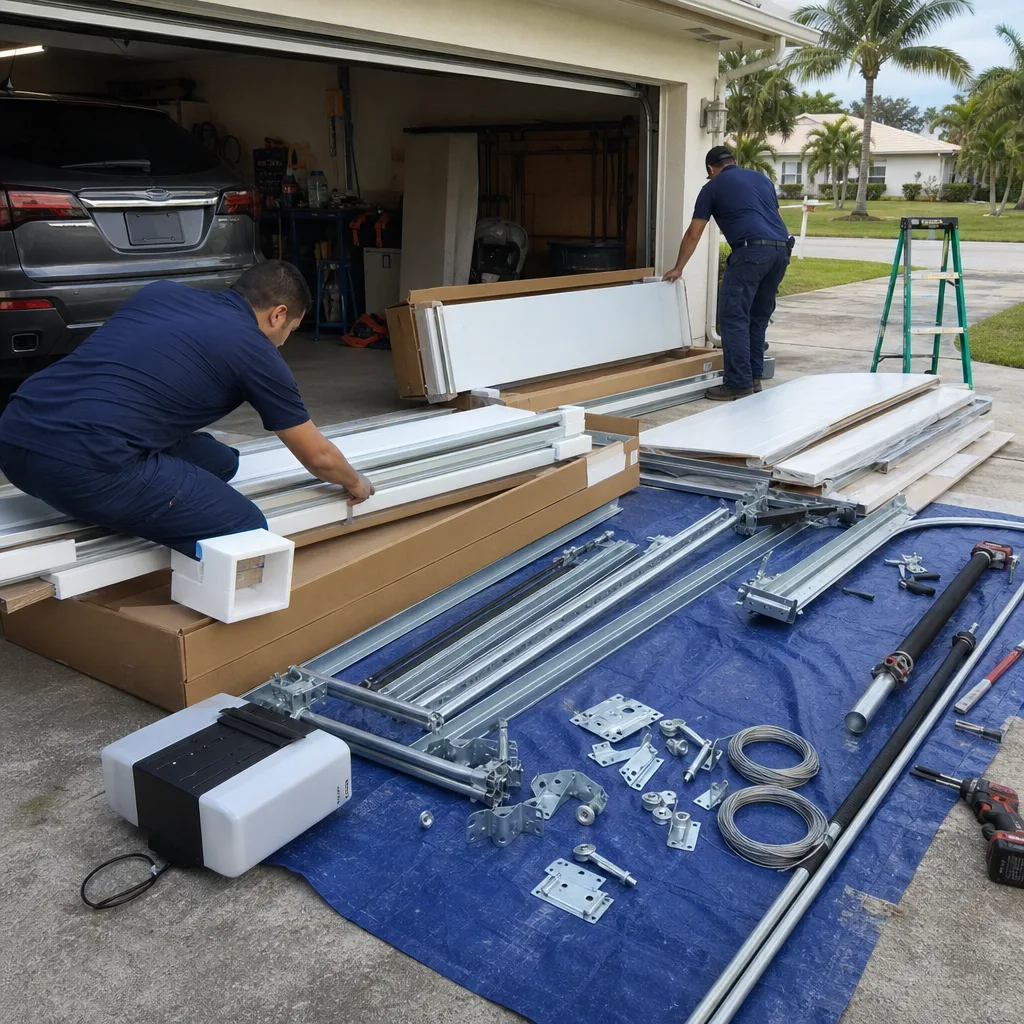
Most garage door warning signs are not emergencies, but three or four of them absolutely are. The skill is in knowing the difference, and the difference comes down to whether the door’s weight-bearing components are involved. If you see a broken spring, a frayed cable, a door that drops, or a separated panel, stop using the door and call. If you hear a grind, see rust streaking, or notice a gap, book a repair on your schedule. Photograph the symptom before you call. Get a written price before you authorize work. That’s the entire framework. For any warning sign on a Davie garage door, call (754) 704-3976 for a free, written estimate with no urgency attached.
Written by Marcus Deller, Owner at Servo Garage Doors Davie, serving Davie since 2015.