
Last updated September 20, 2026
 Before
 After
After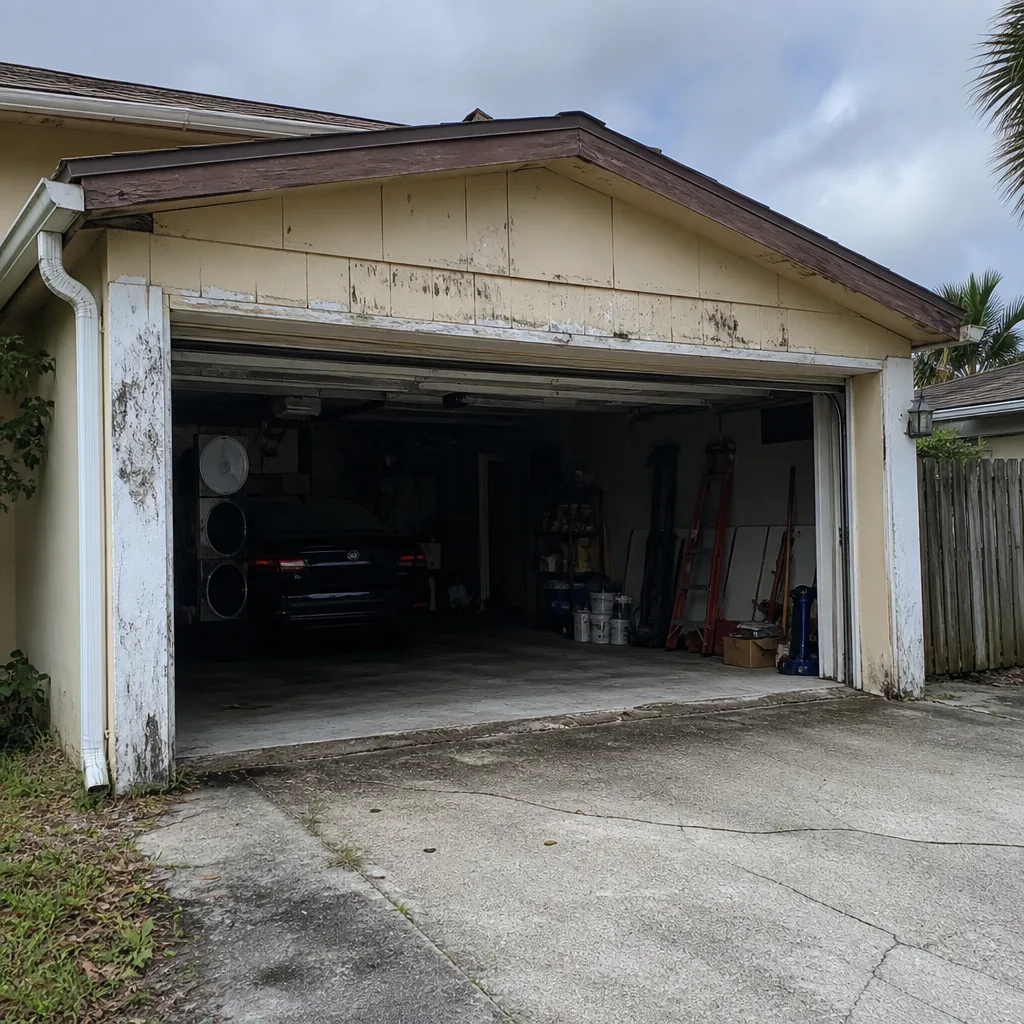 Before
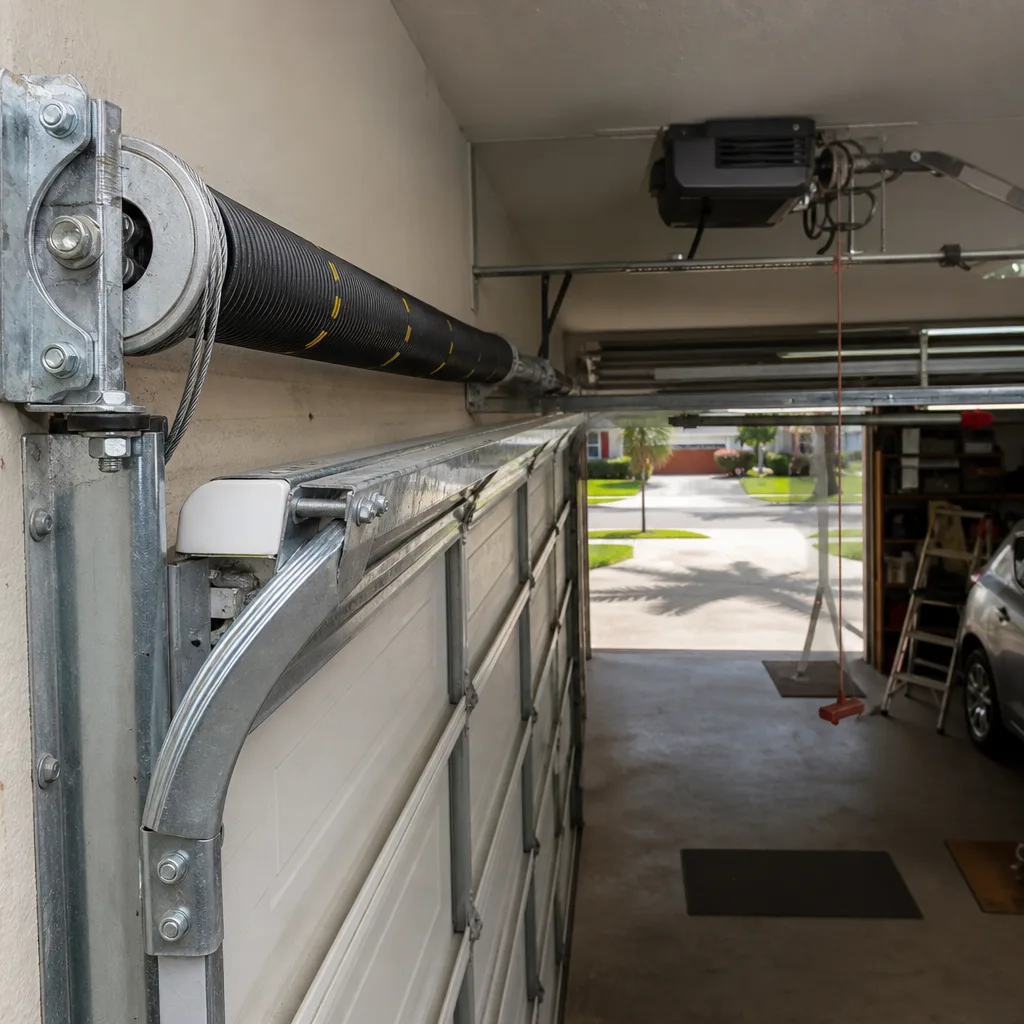 After
After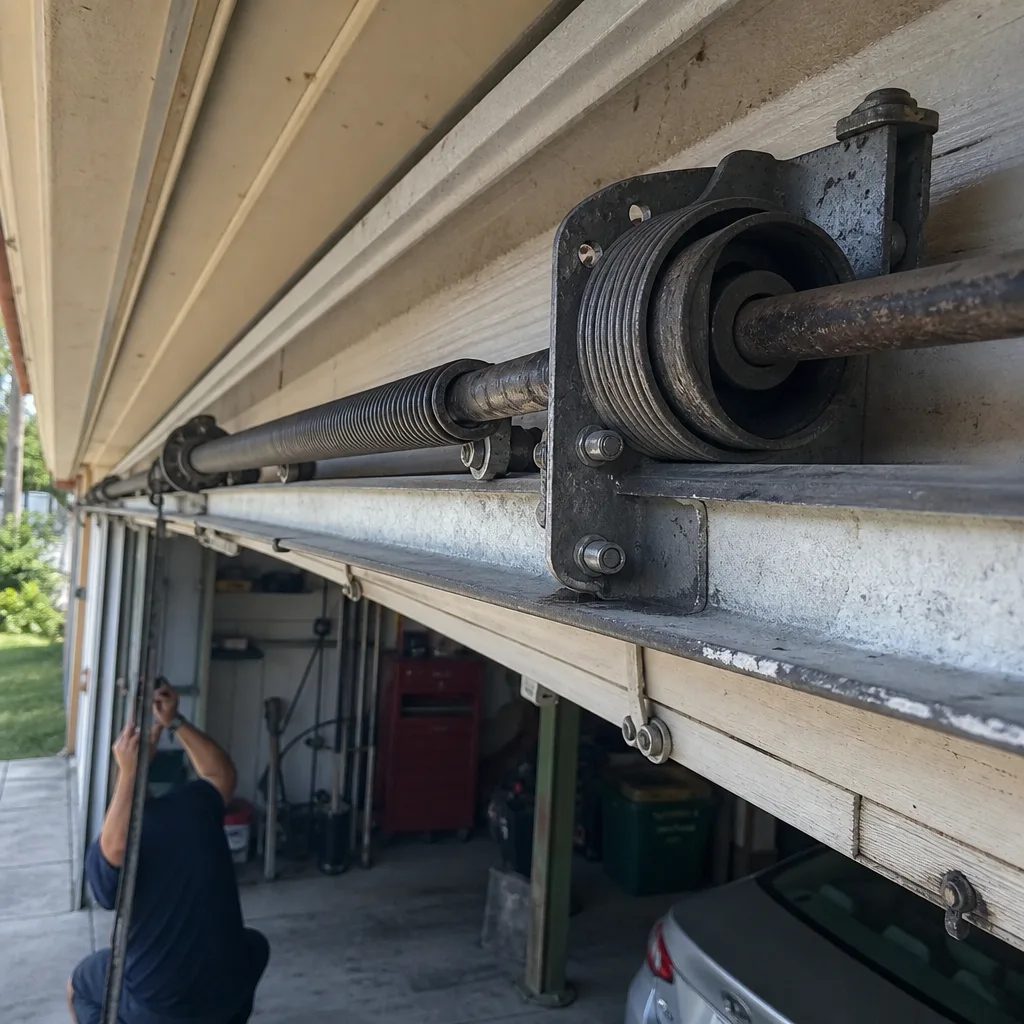 Before
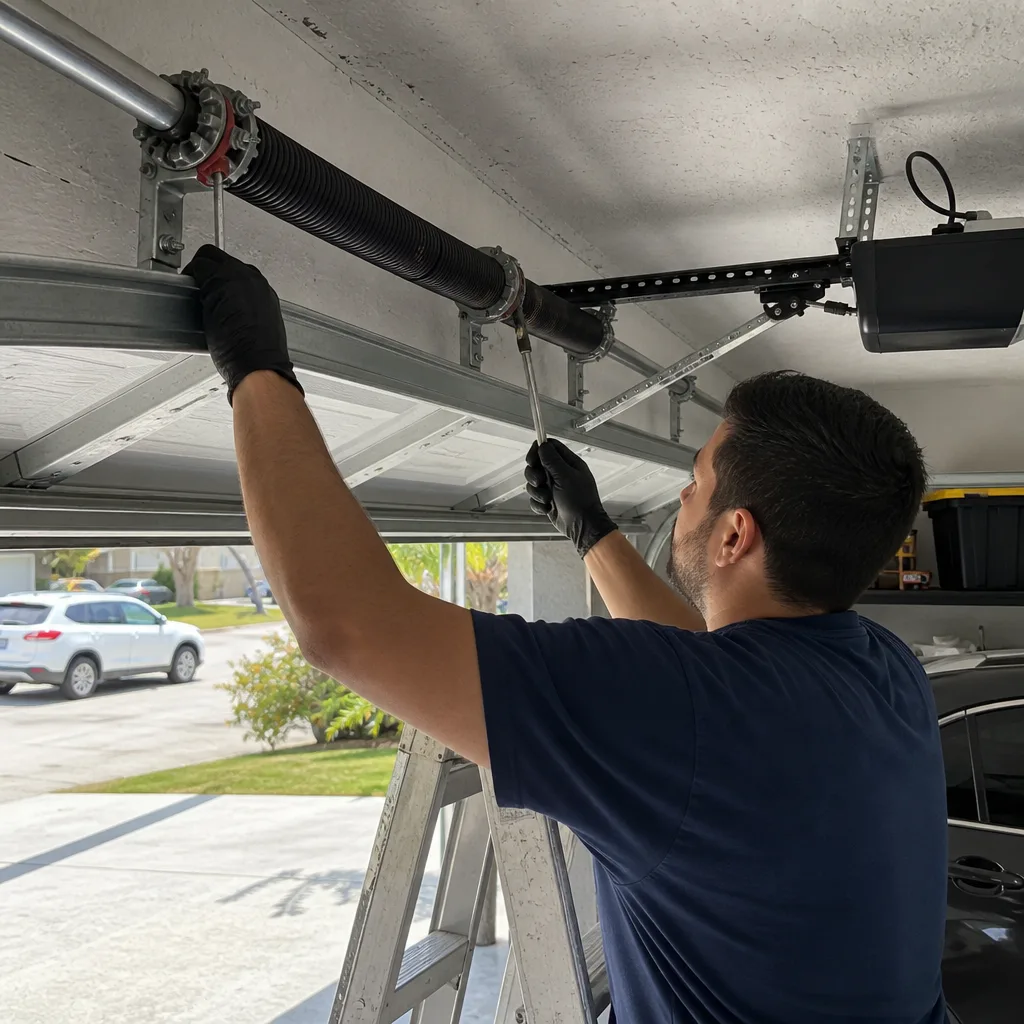 After
AfterTable of Contents
- What Florida Law Says About Garage Door Work
- The Safe DIY List: Five Tasks You Can Handle
- The Three Tasks That Are Never DIY
- Warranty Implications: What the Fine Print Actually Says
- The Cost-Honest Comparison: What DIY Really Saves
- Why Davie’s Climate Changes the Math
- Common Mistakes to Avoid
- When to Call a Professional
- Frequently Asked Questions
- The Bottom Line
What Florida Law Says About Garage Door Work
Florida statute 489 draws a line that most DIY guides ignore. The state distinguishes between maintenance and repair versus installation and structural work. A homeowner may perform maintenance and minor repairs on their own residence without a license. What constitutes a “repair” versus an “installation” under the statute is where the confusion starts.
Legal DIY in Florida:
- Replacing a bottom seal or weather stripping
- Swapping out rollers on a non-load-bearing track section
- Adjusting limit switches and force settings on the opener
- Reprogramming remotes and keypads
- Realigning track brackets that have come loose
- Lubricating hinges, rollers, and springs
Requires a licensed contractor in Florida:
- Installing a new garage door where one did not previously exist
- Replacing an entire door assembly, including tracks and hardware
- Any structural modification to the opening
- Electrical work beyond plugging in an opener
- Work requiring a permit, which most full door replacements in Davie trigger
The practical takeaway from a decade of serving Davie: if the task involves swapping a part that’s designed to be replaced, you’re likely in legal DIY territory. If the task involves changing the structure, the mounting points, or the tension system, you’re in licensed-work territory. When in doubt, Broward County’s building department will answer the question directly, and at Servo Garage Doors Davie home we’ve never charged a homeowner for asking us to evaluate whether a project needs a permit.
One more nuance worth knowing: Davie’s municipal code enforcement treats unpermitted door installations as a sale-time disclosure issue, so understanding Garage Door Permits, Codes & Inspections in FL: What You Need to Know before you start matters. A door installed without the proper permit becomes a title defect when you sell the house. That’s not a scare tactic. It’s the reason we photograph the permit documentation as part of every installation job we complete.
The Safe DIY List: Five Tasks You Can Handle
If you own a socket set, a level, and a flathead screwdriver, you have the tools for roughly 70% of what goes wrong with a garage door. These five tasks are genuinely DIY-appropriate, and doing them correctly in Davie’s climate will extend the life of your door by years.
1. Bottom Seal Replacement
The rubber strip along the bottom of your door degrades faster in South Florida than almost anywhere else in the country. UV exposure, standing water during summer storms, and the expansion-contraction cycle from Davie’s heat all accelerate the breakdown. You’ll know it’s time when daylight shows under the closed door or you find water, leaves, or lizard droppings inside the garage. The job takes 20 minutes: pull the old seal out of its track, slide the new one in, trim the ends. A replacement seal costs $25 to $45 at any Davie hardware store.
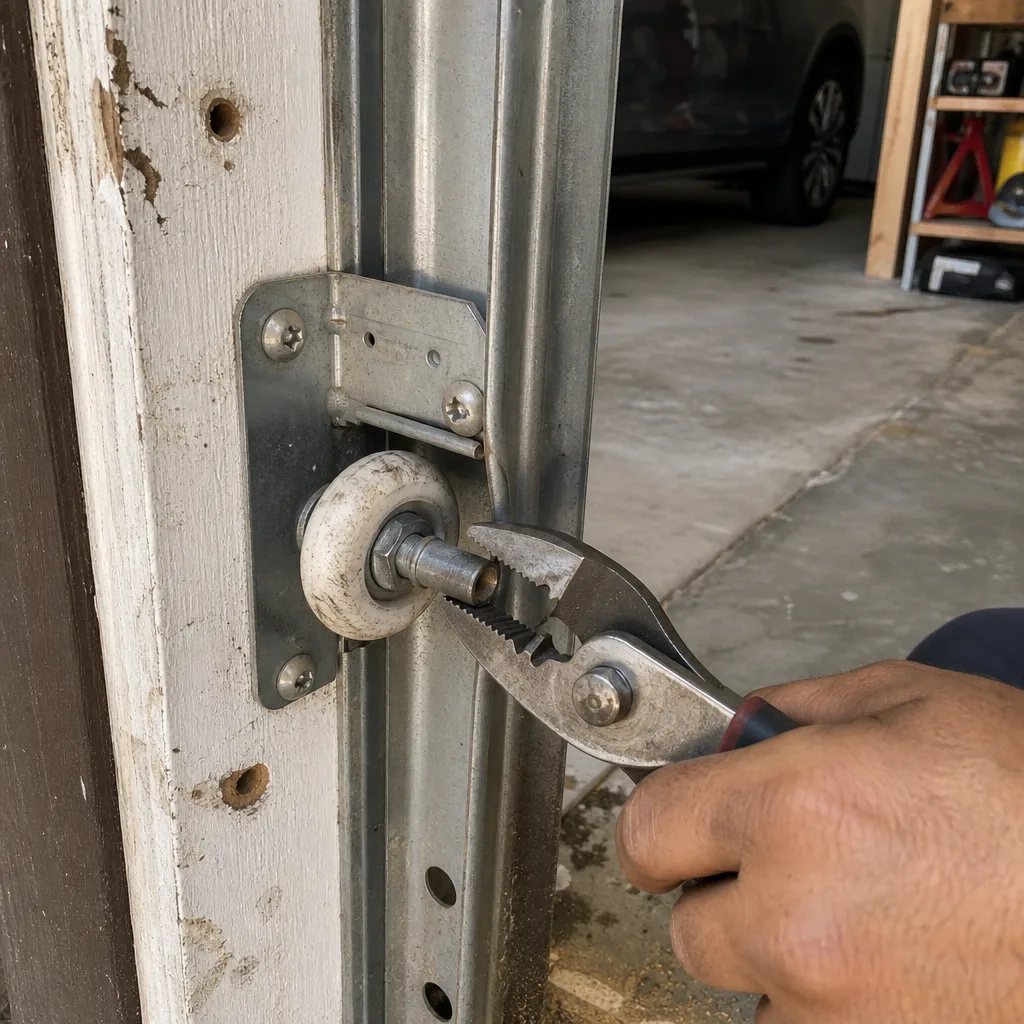
2. Roller Replacement (Non-Tensioned Sections)
Most garage doors have rollers on two types of track sections: the vertical sides and the horizontal curve near the ceiling. The vertical track rollers on a door with a torsion spring system are generally safe to replace without winding or unwinding the spring. The critical rule: never remove a roller from the bottom bracket. Those bottom brackets are bolted to the spring cable assembly and under load. The top and middle rollers, by contrast, slide out with the door up and the track held steady. A pair of quality nylon rollers runs $10 to $15 and cutting down the metal-on-metal grinding is worth it in a Davie garage, where humidity rusts steel rollers faster than most homeowners expect.
3. Limit and Force Adjustments
Your opener has two adjustments: the limit switch tells the motor when the door is fully open or closed; the force adjustment tells the motor how hard to push before it reverses. When a Davie door starts reversing randomly in the summer, it’s usually heat-related expansion changing the balance just enough to trip the force sensor. The fix is two screwdriver turns on the opener head, not a service call. Every opener manufactured after 1993 has this as a user-serviceable adjustment, and the owner’s manual covers it. This is the single most common issue we’re called for that the homeowner could have fixed in 90 seconds. If you have a Craftsman or Chamberlain opener, the adjustment dials are on the rear of the motor head and clearly labeled.
4. Remote Programming
New remote, lost remote, or a remote that stopped working after a lightning storm in Davie’s summer afternoons. Programming is a five-minute job with the “Learn” button on the opener head. If your opener is older and lacks a Learn button, you have DIP switches and the process is slightly more tedious but still documented in the manual. This is DIY by design: manufacturers expect homeowners to handle this. If you’re in a Davie neighborhood like Pasadena Estates or Harmony Lakes, learning the programming sequence once saves you a service call fee every time a remote dies or a new car needs pairing.
5. Track Alignment
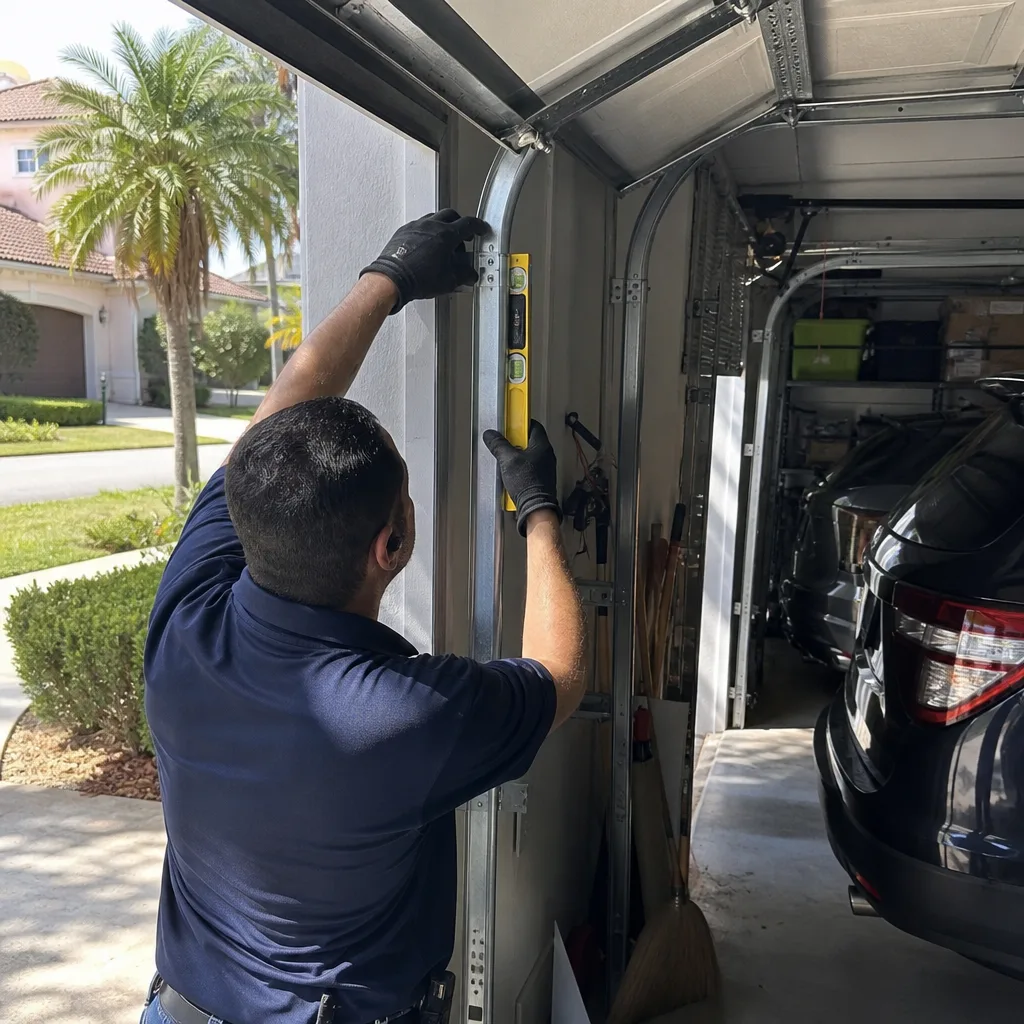
Garage door tracks are held to the wall by brackets. Over time, vibration loosens the bolts, and the track drifts out of parallel. This causes the door to hesitate, bind, or squeal on the way up. The fix is straightforward: loosen the bracket bolts, tap the track back to vertical with a rubber mallet, check with a level, re-tighten. The critical safety note: this applies only to the vertical track sections. The horizontal tracks, where the cables and drums live, are part of the tension system and should be left alone. If the door is binding on a horizontal section, that’s a spring tension issue, not an alignment issue, and it belongs in the professional category.
The Three Tasks That Are Never DIY
This is not about lacking faith in your ability. These three tasks are the ones where the physics, the law, and the warranty language all converge to make DIY the wrong decision. Every professional in Davie knows someone who tried one of these and was lucky to walk away with a hospital bill instead of something worse. We’re not going to describe step-by-step methods for any of these, because even describing the process can encourage attempts. Here is what you need to know.
Torsion Spring Replacement and Winding
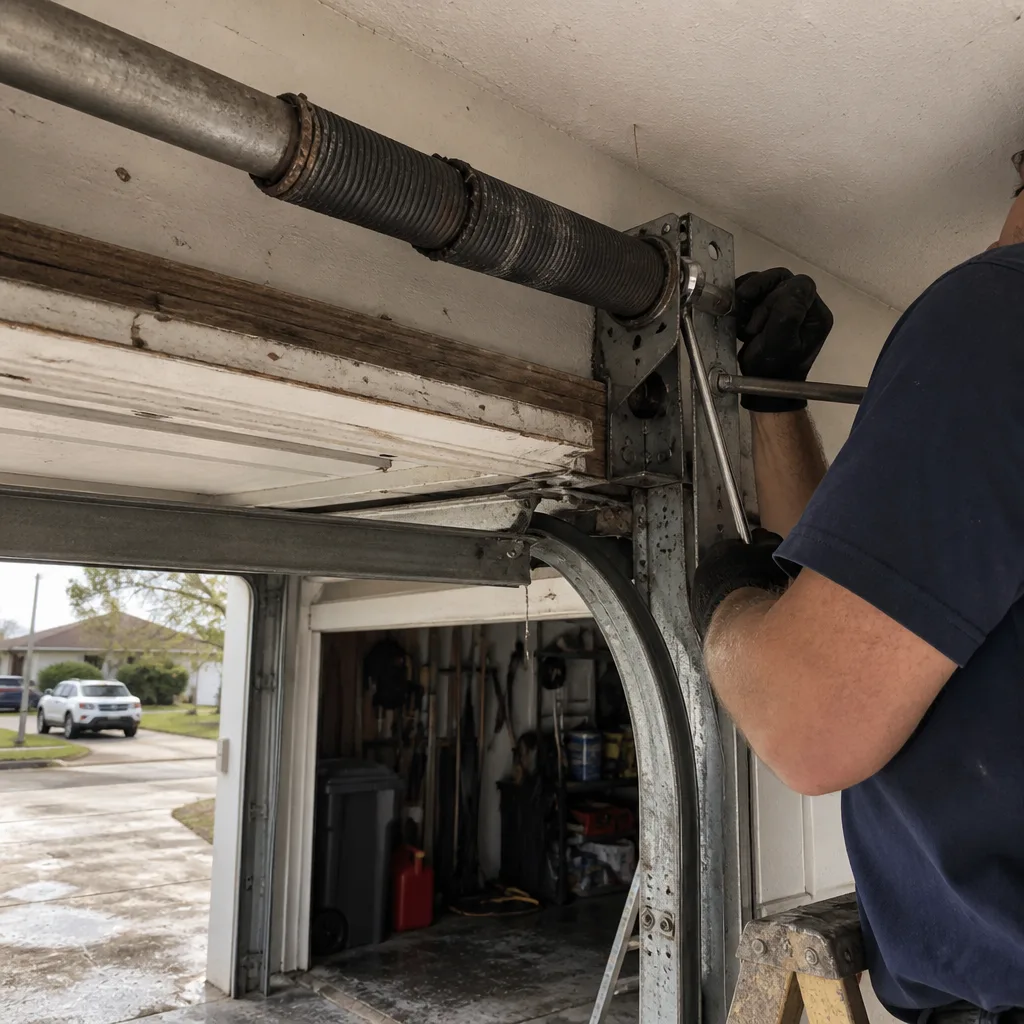
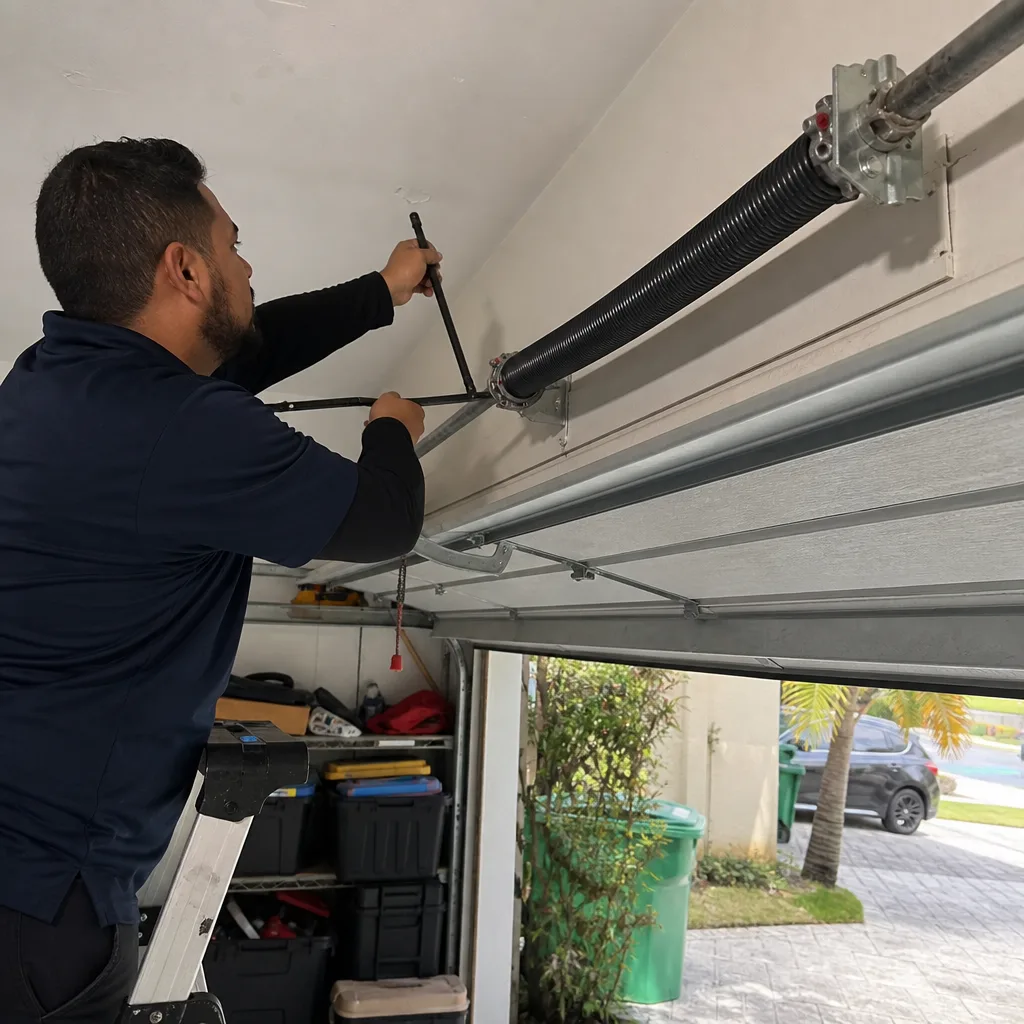
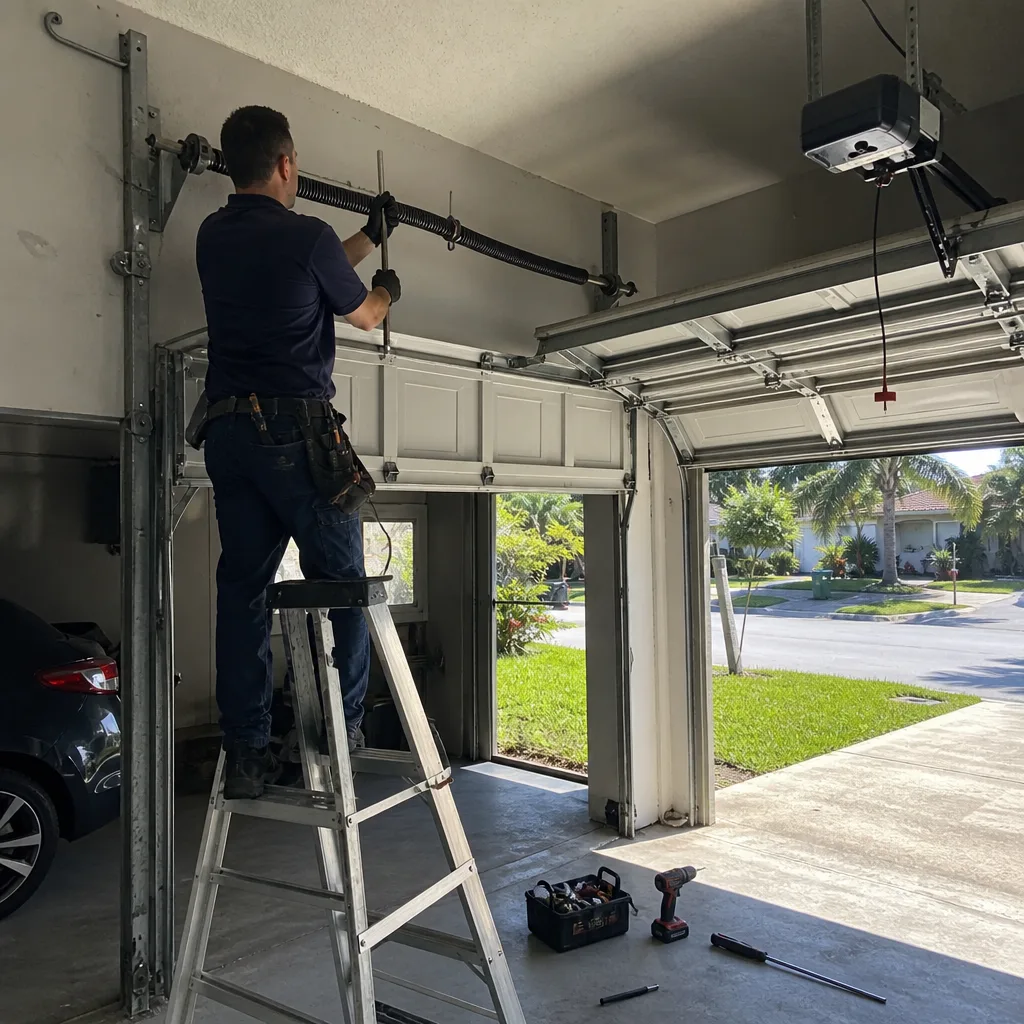
The torsion spring is the coiled steel shaft mounted above your garage door opening. It counterbalances the door’s weight, and it does so under extreme tension. A fully wound residential spring holds enough stored energy to break bone, sever tissue, and cause fatal injury if it releases uncontrolled. This is not a statistic we cite to frighten anyone. It’s the reason the winding bars used for this job are two feet of solid steel, and the reason the spring manufacturer stamps torque ratings on the spring itself. Springs also fail predictably: they have a cycle life, usually 10,000 cycles, and when they break, they snap with enough force to dent the wall. In Davie’s humidity, springs rust from the inside and can fail before their rated cycle count. The professional replacement takes about an hour and requires matching the spring’s wire diameter, inside diameter, length, and winding direction to the door’s exact weight. A mismatch means a door that flies up, falls down, or tears the opener off its mounts.
Cable Drum Replacement Under Tension
The cables running from the bottom brackets up to the drums on either end of the torsion shaft are what actually lift the door. They are wound tight, and they stay wound tight even when the door is open. If a cable frays and you attempt to replace it without first unwinding the springs, you’re dealing with the same stored energy as the spring itself. If you replace the cable with the spring still wound, the drum can spin when tension shifts, and that’s where injuries happen. A frayed cable also tells you something about the spring: it usually frays because the door is unbalanced, and an unbalanced door is a spring problem. In our experience in Davie, a frayed cable is symptom, not root cause, and the fix requires addressing both.
New Door Installation (Permit-Required Work)
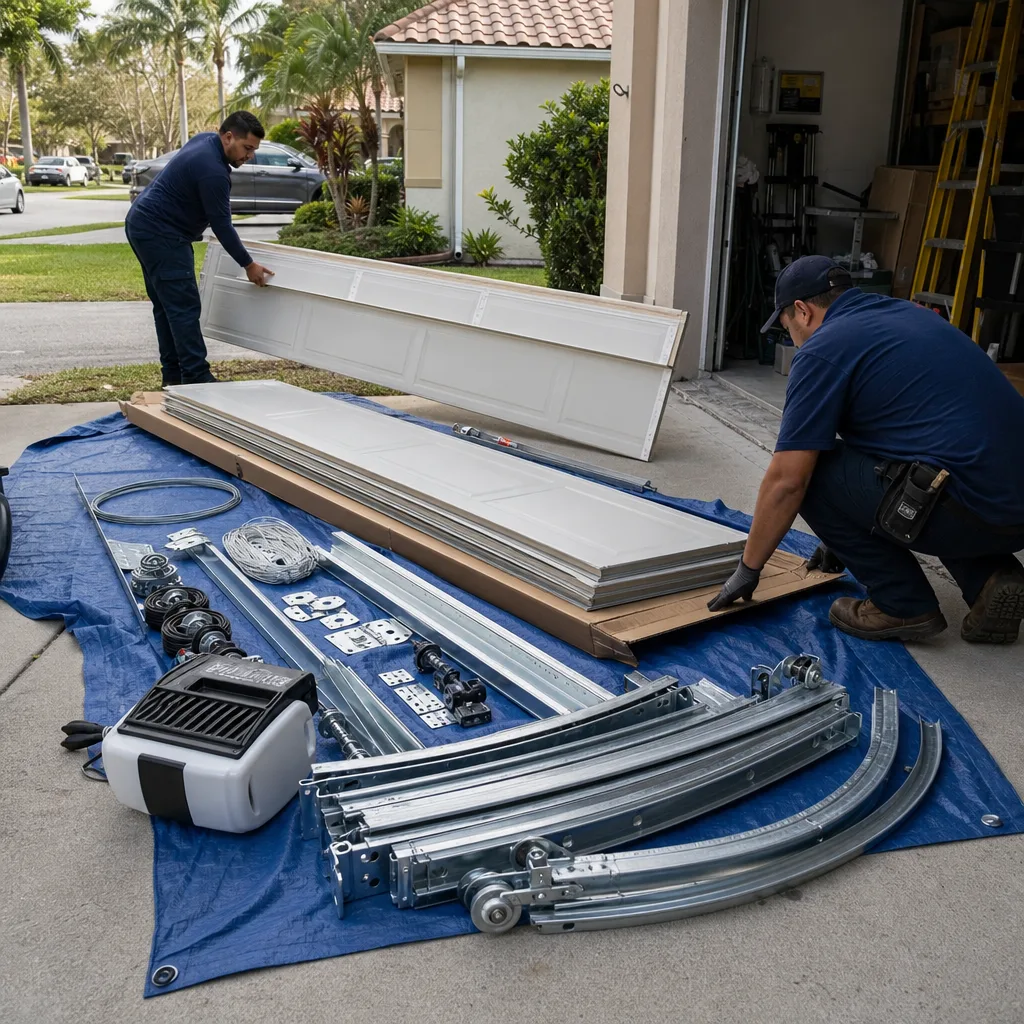
Installing a new garage door in Davie is not the same as replacing a water heater. The door is a structural component of the opening, which means the work triggers Broward County permit requirements. A permitted installation includes wind-load compliance, which matters in a town that sits in the middle of South Florida’s hurricane zone. The track system must be anchored to code, the opener must be hard-wired or properly socketed, and the finished work must pass inspection. If you install a door without a permit and sell the house, the unpermitted work becomes a title issue. This is the rare case where the cost of professional installation isn’t just about doing it right. It’s about having the paperwork that proves it was done right. At Garage Door Installation in Davie, we handle the permit application as part of every full door replacement, and the homeowner gets a copy of the final inspection record.
Warranty Implications: What the Fine Print Actually Says
Most homeowners never read the warranty card until the claim is denied. When it comes to garage doors, the warranty language is specific about DIY work, and it varies by manufacturer. Here is what the actual policy documents say.
Spring replacement: Wayne Dalton publishes its warranty terms in the door owner’s manual, and the language specifies that torsion spring replacement must be performed by a trained professional or the door warranty is void. Amarr includes similar language, and both manufacturers cite the safety risk as the rationale. The practical effect: if you replace your own torsion spring and the door later fails due to a related issue, the manufacturer will deny the claim, and you’ll pay for the door, the tracks, and the installation out of pocket. A professional spring replacement, by contrast, preserves the door warranty and carries its own parts warranty.
Roller replacement: Most manufacturers consider roller replacement to be normal maintenance, the way a car manufacturer treats brake pads. Raynor, Amarr, and Wayne Dalton all allow DIY roller replacement without voiding coverage, provided the work doesn’t cause the damage you’re claiming. The same applies to bottom seal replacement and lubrication. What voids coverage is not the specific part you replaced. It’s the result: if DIY work caused or contributed to the failure, the warranty doesn’t pay.
Opener warranty specifics: Craftsman and Chamberlain opener warranties are more permissive on DIY work like remote programming and limit adjustments, but both exclude coverage for damage caused by an improperly balanced door. If you adjust force settings on an unbalanced door and the opener burns out as a result, the warranty claim will reference the original installation and balance state, and you’ll be paying for a new opener. We’ve seen this happen in Davie more times than we can count, usually after a homeowner replaced springs themselves and set the door balance incorrectly.
The short version: DIY maintenance like rollers and seals is warranty-safe. DIY spring work and balance-related adjustments are warranty-risky, and the risk lands on your wallet if the failure happens later.
The Cost-Honest Comparison: What DIY Really Saves
Every DIY calculation assumes the job goes right the first time. That assumption is usually wrong, and the honest comparison accounts for tools, time, and the cost of a professional fix when the first attempt fails. Here is the math for Davie homeowners, using actual local pricing ranges.
| Task | DIY Cost | Professional Cost | Actual Savings |
|---|---|---|---|
| Bottom seal replacement | $25-$45 in parts, 20 minutes | $110-$160 | $70-$115 |
| Roller replacement (5-6 rollers) | $50-$90 in parts, 1 hour | $140-$220 | $50-$170 |
| Limit/force adjustment | $0, 15 minutes | $95-$140 service call | $95-$140 |
| Remote programming | $0, 10 minutes | $75-$110 service call | $75-$110 |
| Track realignment (vertical only) | $0, 30 minutes | $120-$180 | $120-$180 |
| Torsion spring replacement (one spring) | $60-$120 in parts, plus $40-$60 in winding bars, plus hospital risk | $225-$350, done in one visit | Negative value when risk is priced in |
The legitimate DIY savings on maintenance tasks are real: $50 to $180 per task depending on the part. Across a typical year of Davie garage door ownership, a homeowner who handles the five safe DIY tasks themselves saves roughly $400 to $600 compared to calling a professional for every issue. That’s not nothing. But notice the spring replacement line: the parts cost looks tempting, and that’s exactly how people talk themselves into attempting the one repair that should never be DIY. The winding bars alone cost $40, and if the spring slips during winding, the door becomes a 150-pound free-fall hazard and the spring becomes a projectile. The professional cost includes the correct spring matched to the door’s weight, the winding work, the balance check, and the disposal of the old spring. What it doesn’t include is an emergency room visit.
We also see the failed-DIY repair in Davie regularly. It usually happens on a Sunday afternoon, after the homeowner has watched a video, gotten halfway through, and realized the spring doesn’t match or the cable has come off the drum. At that point, the door is stuck halfway, the garage is trapping a car inside, and the professional call is urgent. The fix costs more because the partial work has to be undone before the correct work can start. The honest math says: DIY the maintenance, not the tension system.
Why Davie’s Climate Changes the Math
Garage door parts fail differently in Davie than they do in Arizona or Michigan. The combination of humidity, salt air from the coast, and morning-to-afternoon temperature swings creates specific failure patterns that every Davie homeowner should understand.
Rust accelerates: Steel rollers, hinges, and track hardware rust two to three times faster in Davie’s humidity than in dryer climates. The first symptom is usually a grinding sound on the way up, followed by visible rust staining on the track. Replacing steel rollers with nylon rollers early is the single best preventive move a Davie homeowner can make, and it’s a DIY task.
Seals fail from UV and water: The bottom seal takes a beating from UV exposure and standing water during summer downpours. A seal that’s cracked or compressed makes the garage vulnerable to water intrusion, and even a half-inch gap is enough to let mosquitoes in, which matters in a town where mosquito control is part of daily life. Replacing the seal annually is cheap insurance and a 20-minute DIY job.
Springs fatigue from heat cycles: Torsion springs have a cycle rating, but heat accelerates metal fatigue. A spring rated for 10,000 cycles in a temperate climate might fail at 7,000 or 8,000 in Davie, especially if the garage is uninsulated and the spring bakes in afternoon sun. This is why we recommend upgrading to high-cycle springs when replacement time comes, and why the spring replacement is always professional work.
Storms create tension: South Florida wind loads stress the door structure, and after a strong storm, tracks can shift, cables can loosen, and the door can go out of balance. If your door suddenly feels heavy or opens unevenly after a storm, the balance is off, and that’s the wear point that leads to spring failure. A professional can adjust this before it turns into a snapped spring. Our Garage Door Repair in Davie service routinely handles storm-related imbalance, often the week after a named storm passes through.
Common Mistakes to Avoid
- Attempting spring work without understanding the door’s weight. A spring that’s too strong will send the door flying up; too weak will drop the door. Both are dangerous, and both are easily misdiagnosed by a homeowner measuring spring length instead of wire diameter.
- Disconnecting the opener while the door is up. The emergency release cord only works safely when the door is fully closed. Pulling it while the door is open, especially on a door with a broken spring, turns the door into a falling object. This is how Davie homeowners end up with bent track sections and cracked panels.
- Replacing cables without addressing spring balance. A frayed cable is almost always caused by an unbalanced door. Replacing the cable alone solves nothing and puts you back in the same situation within months.
- Ignoring the permit requirement on door replacement. A full door installation in Davie requires a Broward County permit. Skipping it saves you a few hundred dollars now and creates a title issue when you sell.
- Buying parts based on price instead of specification. A $20 spring from an online marketplace that doesn’t match your door’s weight is worse than a broken spring. It’s an unknown load on a system you can’t safely test. Match the wire gauge, inside diameter, and length, or let a professional match it.
- Waiting until the door fails completely to address a balance issue. By the time a door won’t open, the spring has already failed or the opener has already burned out. A door that’s heavy to open manually, or that doesn’t stay in place halfway, is the early warning. Listen to it.
When to Call a Professional
Call a professional when the spring breaks, when a cable frays, when the door comes off its tracks, when the installer needs a permit, or when the door is so unbalanced you can’t lift it with one hand. These are not judgment calls. They’re the points where the stakes are too high for a socket set and a YouTube video. If you’ve lost a spring in Davie, Garage Door Opener Repair & Installation in Davie can be handled by the same team that handles the door itself, and we carry both on the same truck. Servo Garage Doors Davie offers free estimates on all work, with a written price and written scope delivered before anything starts. Call (754) 704-3976, and a real person answers, day or night.
Frequently Asked Questions
Yes, maintenance and minor repairs on your own home are legal under Florida statute 489, including bottom seal replacement, roller swaps on non-tensioned sections, limit adjustments, and remote programming. Installation and structural work require a licensed contractor and, in most Davie cases, a Broward County permit.
Torsion spring replacement in Davie typically runs $225 to $350 per spring, including the spring, the winding work, the balance check, and disposal of the old spring. High-cycle springs, which we recommend for Davie’s climate, run $300 to $400. Call (754) 704-3976 for an exact quote, and be aware that a written price is required before any work starts.
Yes, roller replacement is considered normal maintenance by major manufacturers like Amarr, Wayne Dalton, and Raynor, and it does not void the door warranty as long as the work doesn’t damage the door. Stick to the top and middle rollers, never the bottom bracket rollers, which are under cable tension.
Yes, full door replacement in Davie triggers a Broward County permit requirement, including wind-load compliance. The permit is usually handled by the installing contractor, and the final inspection record becomes part of your home’s documentation. An unpermitted installation becomes a title issue when you sell the house.
For a complete schedule, see our Garage Door Repair Maintenance Checklist for Davie Homeowners: replace the bottom seal annually, lubricate the hinges and rollers with a silicone-based lubricant every four to six months, check track alignment and bolt tightness quarterly, and test the door balance monthly by disconnecting the opener and lifting the door manually. A balanced door stays in place halfway. If it doesn’t, call a professional before the spring fails.
Yes, free estimates are standard, and a written price and written scope are delivered before any work starts. This is not a request-based courtesy. It’s how the company has operated since 2015, and it’s written into the operating standard. Call (754) 704-3976 and a live person answers, including nights, weekends, and holidays.
The Bottom Line
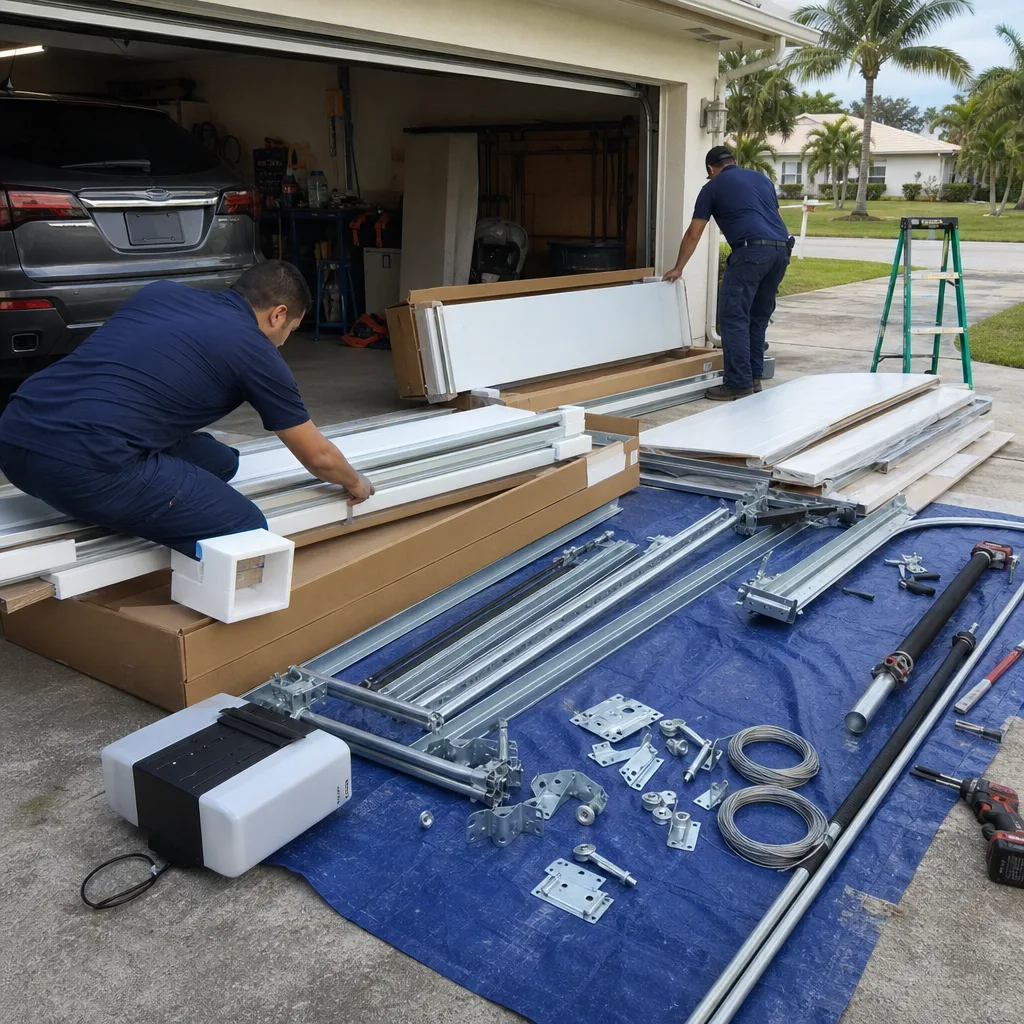
The DIY-versus-professional decision for garage doors in Davie comes down to three questions: Does the task involve tension? Does it require a permit? Does the manufacturer’s warranty care who did the work? If the answer to all three is no, you’re looking at a legitimate DIY task that can save you $50 to $180. If the answer to any one of them is yes, call a professional, get a written price before work starts, and keep the paperwork. That’s the entire decision guide in three sentences, and it’s the same framework we’ve used to fix over 18,000 doors in Davie since 2015.
Written by Marcus Deller, Owner at Servo Garage Doors Davie, serving Davie since 2015.